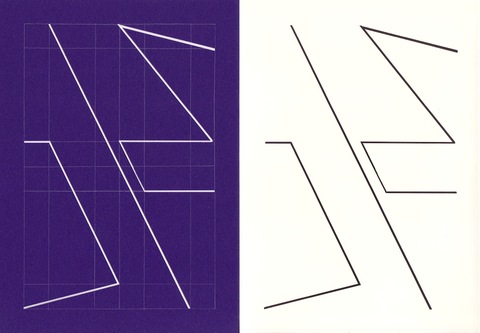
Richard Caldicott: Fragmentation, Abstraction, Post-Abstraction and
De-Abstraction

Jonathan Bell


At first glimpse, the work of Richard Caldicott speaks little of
modernism's century-long journey and appears concerned instead with creating
detached, ahistorical compositions. Yet within these fragmented views
one can discern multiple interpretations, the most central of which is
modernism's contemporary role and image. Following early experimentation
with collage, Caldicott experimented with work that fell broadly into
the still life genre, with compositions that were constructed
- literally - from a series of everyday objects, most memorably Tupperware
containers. There was a playful irony in this particular source material,
given the way in which consumer aspirations appear to follow unlikely
yet ultimately predictable routes through the past strata of material
culture, elevating the everyday into contemporary fetishes before moving
on to something else, and underlying subtle conflicts remain central to
his work.

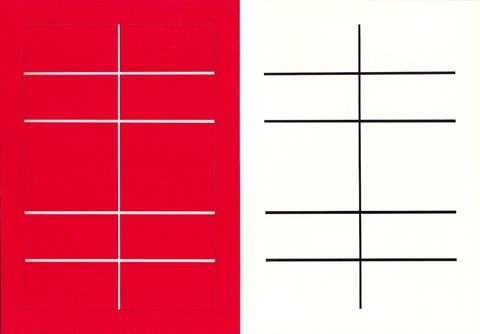
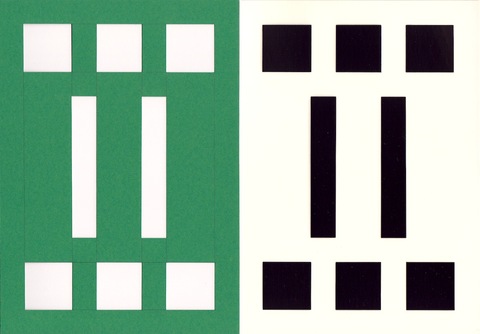
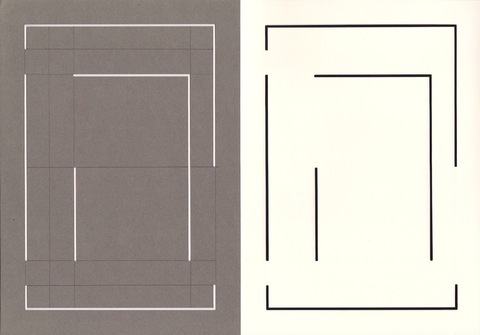
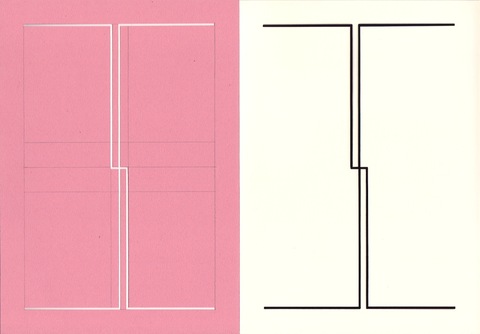
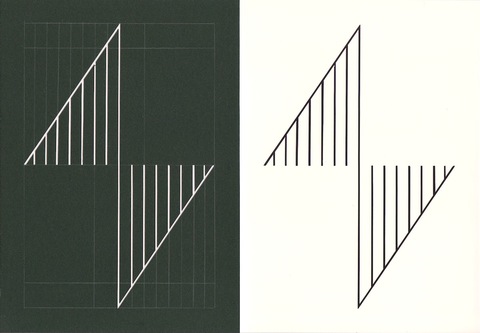
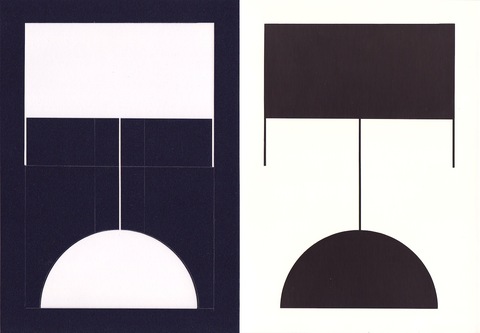
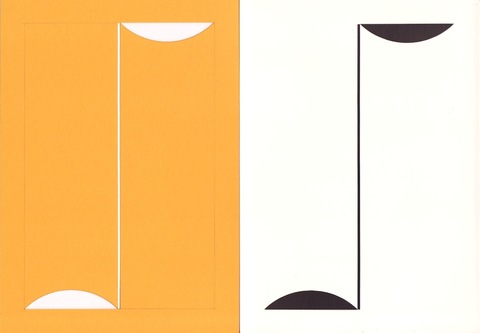
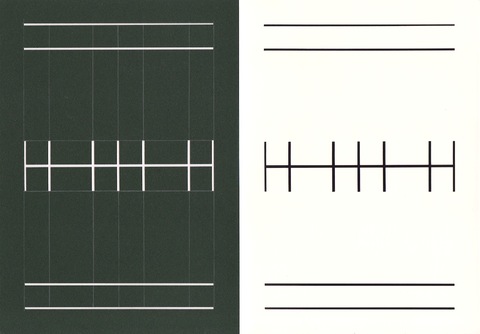
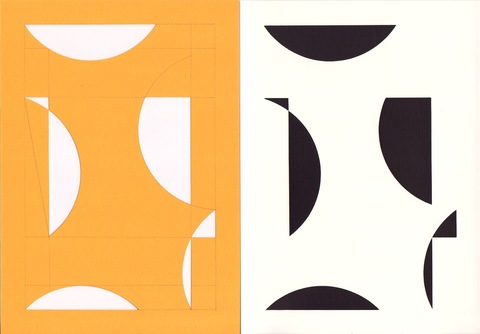
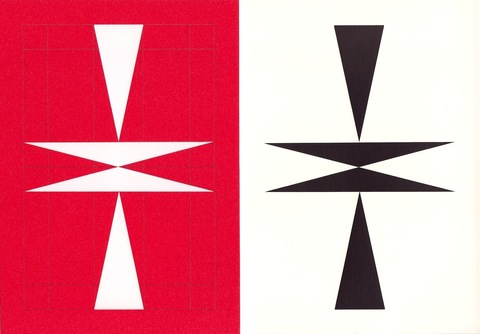
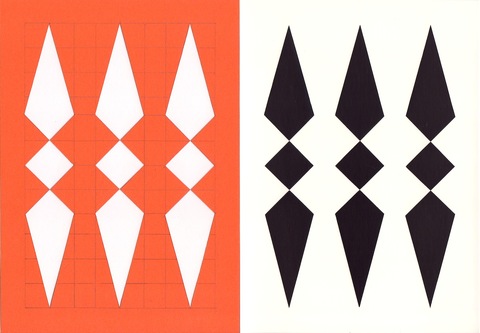
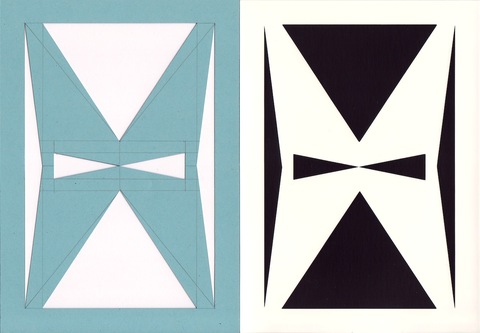
Caldicott still works with collage and recent pieces have demonstrated
a deliberate honesty about making reference to, say, modernist
architecture, using dissembled floor plans, or fragmented diagrammatic
elements. For the lateral-minded viewer these works superficially evoke a
roll-call of celebrated modernist image-makers - Judd, Prouve, Mendelsohn,
Foster, Schindler, van der Rohe, Mondrian, Rietveld, Malevich, et al.
However, one must consider that in the decades following their signature
works, these artists have themselves been abstracted, reduced to a
series of signature works, frozen images that illustrate a long-accepted -
and largely unchanging - story of modernism.

Classical art provided the viewer with a fixed perspective, an overall
view that cannot change in order to give the artist complete control
over the viewer's response: the composition directs the viewer's gaze.
Classical architecture played a similarly dominant role, providing key
vistas and alignments that set out scale, hierarchies and social
structure; Versailles as a physical manifestation of the Sun King's divinity,
or a law court as an imposing source of order and power. Abstract art
was primarily a challenge to this hierarchy, a means of testing the
previously accepted limits of artistic representation. At first, it was an
aesthetic movement, one which evolved into an intellectual discussion,
then a visual paean to the nascent machine age that was to be
irreparably scarred by the chaos of the century's conflicts. From then on, the
abstraction generated by the machine be it the printing press, the
camera, the railway, automobile, aeroplane or even the explosion of a
1,000 pound shell was constrained by politics, a series of ideas that
strove for some kind of theological consistency in the turbulent
inter-war period, often marshalled for conflicting ideologies.

Modernism began in opposition to classical formality but quickly
evolved its own hierarchies. For the most part, the movement evoked rigour
and statis, with no room for expressionism or emotion. In common with
several contemporary practioners of art and architecture, Caldicott has
chosen to explore the potential for modernism to evoke emotion through
pure form. In a culture predicated on chaos and unpredictability, his
work incorporates one of the most precious contemporary commodities
time and gives it a central role in how an object or place is perceived.
Time, conveyed through the devices of fragmentation, multiple
viewpoints and long exposures, opens up the formality of static compositions.

Caldicott acknowledges that there is a certain luxury in the creation
of pure composition, a luxury denied even the most avant-garde architect
or designer. It's been said that his work is a reaction against the
post-modern excesses of the late 80s and 90s, and part of a general
movement towards the reclamation and reappropriation of the imagery and to
a certain extent the aims of the modernist programme. But Caldicott's
work goes further. Over the course of the twentieth century, modernism
revealed itself to be a chimera, rather than a straightforward and
unassailable doctrine representing the intersection of form, function and
a social programme. Chimeric modernism began with the almost immediate
evacuation of the latter, as art and architecture became harnessed in
the service of covert American foreign policy goals (1), or the
International Style's evolution into a symbol of corporate might, and the
Bauhaus-style villa's slow metamorphosis into an architecture of elitism.

Through his careful, deliberate fragmentations, Caldicott urges us to
go beyond these static interpretations, exploring modernist form: a
search, if you like, for the romantic. Such an approach has parallels with
Peter Doig's paintings of early modernist masterworks in a
romanticised, verdant landscape, or the epic architectural collages of David
Thorpe. At its heart is the question of what it means to be modern, and what
if any emotions can, and should, be sourced from such defined
order. Why did modernist spaces find it so difficult to accommodate human
scale and emotion? Despite the avowed intentions of many architects -
some of whom Caldicott has previously drawn upon for his earlier series -
modernism retains a dehumanised image. Caldicott seeks to return the
fleeting moment to modernism, stripping away its rigour and apparent
inflexibility in a series of glimpses. He acknowledges contemporary
architects and designers taking a similar approach, and Caldicott is
sympathetic to their ambitions; he shares the aim of re-appropriating
modernism's formal language with his abstract compositions. Perhaps this is
heretical, but it's also defiantly anti-postmodernist, a means of eking
further meaning from what have slowly evolved into static cultural
landmarks. While other artists have explored this contemporary stillness - the
depictions of Ed Ruscha and, more recently, Julian Opie, for example,
CaldicottÕs sympathies lie with a more fragmented approach. There may be
similar connections and inspirations, certainly, but Caldicott's
sources are varied and eclectic. Even though the work has no nostalgic
overtones - it's avowedly ahistorical - contemporary architectural themes
prevail.

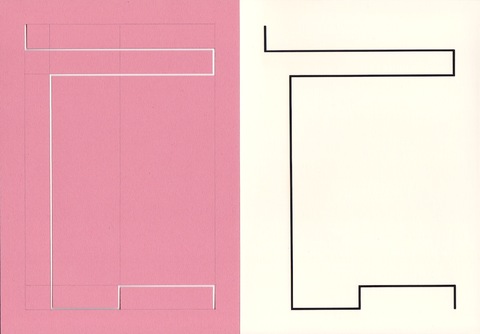
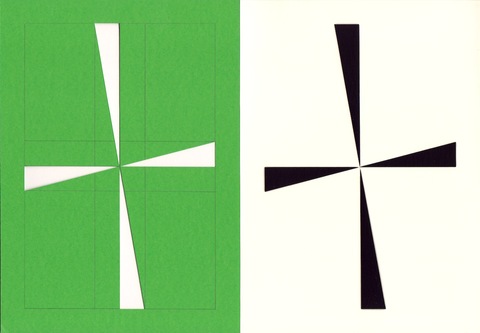
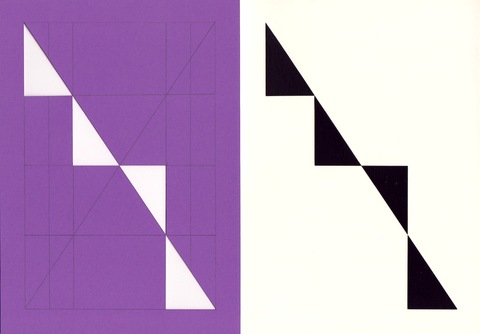
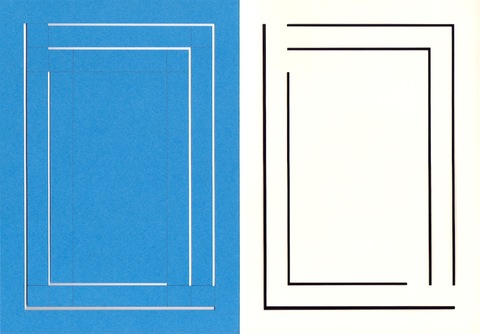
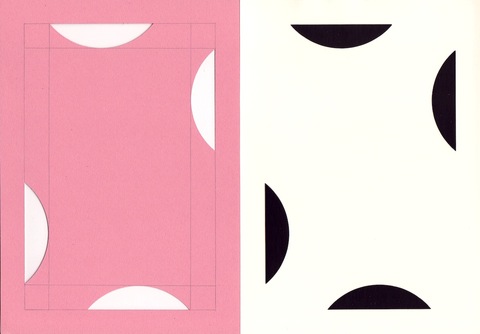
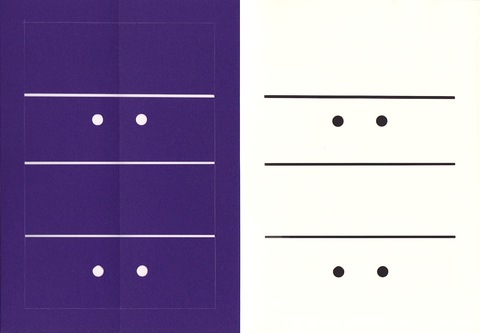
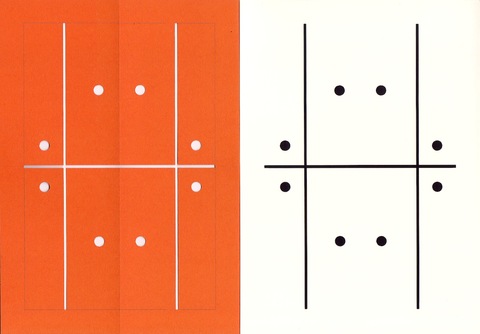
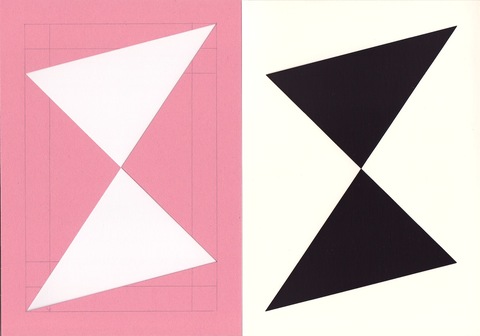
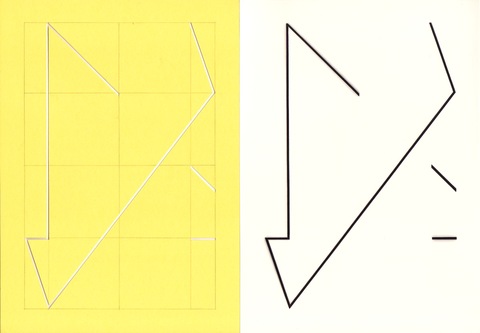
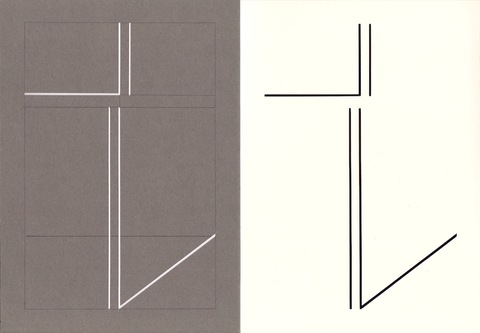
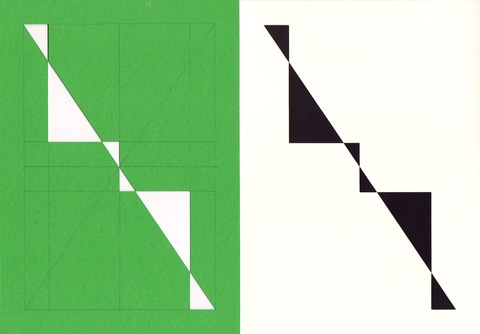
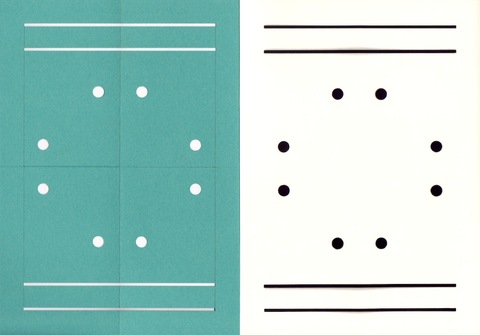
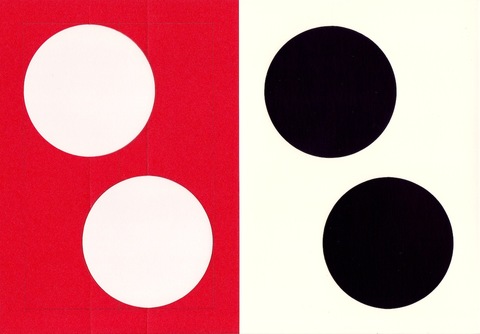
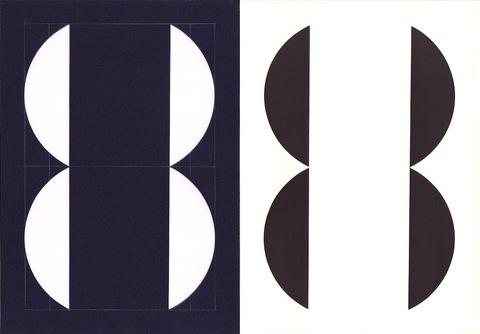
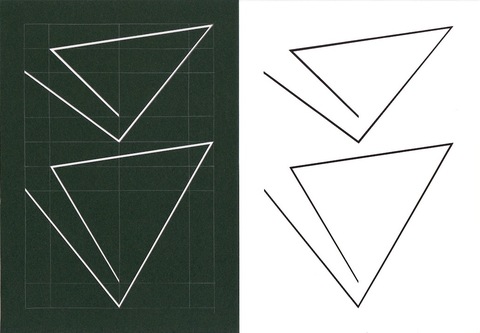
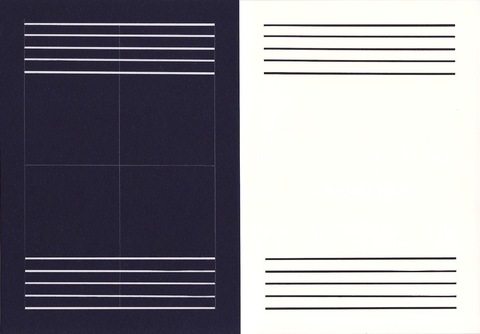
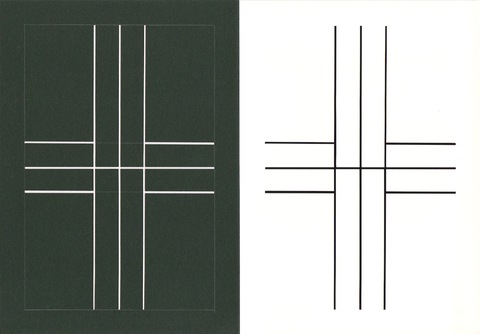
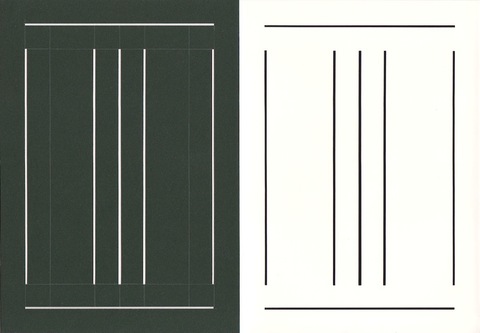
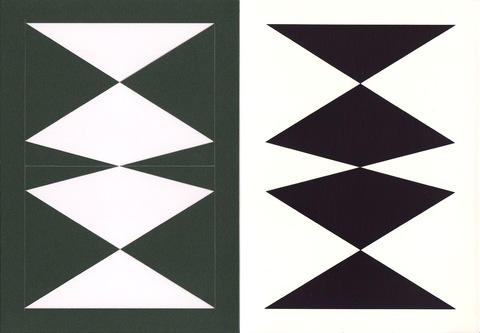
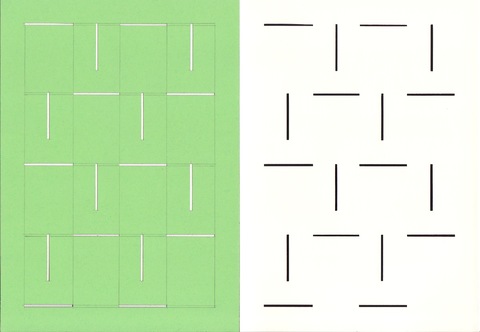
There are no underlying data sources in Caldicott's work, no
extrapolations from telling statistics woven into the pattern, or symbolic colour
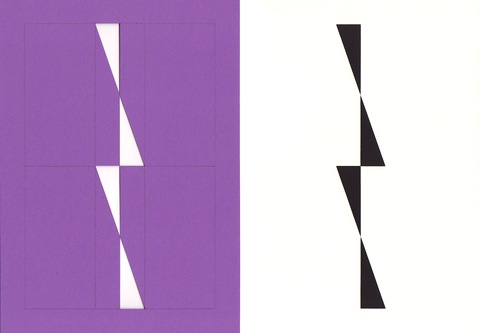
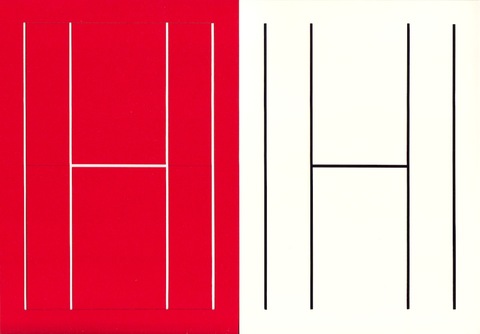
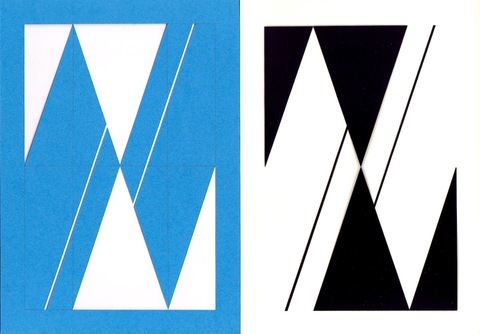
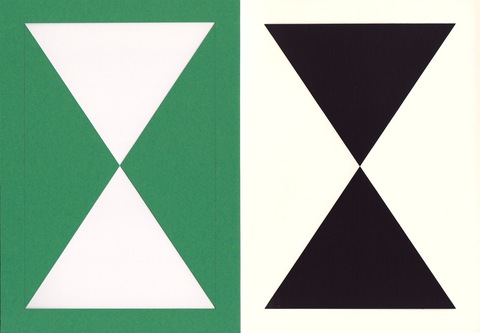
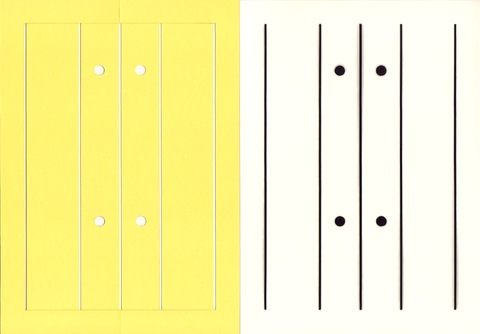
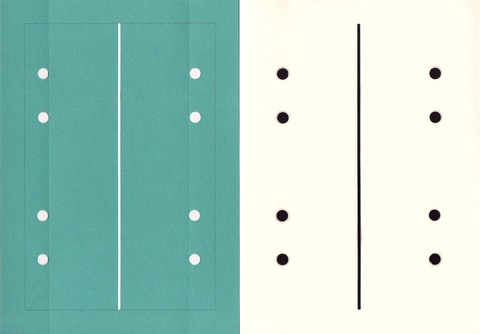
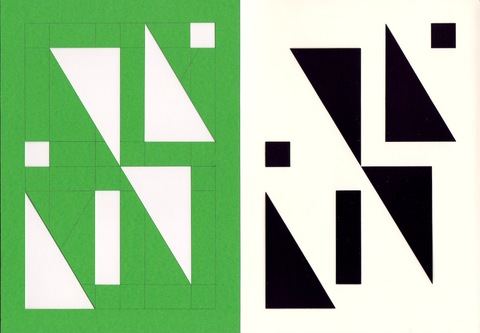
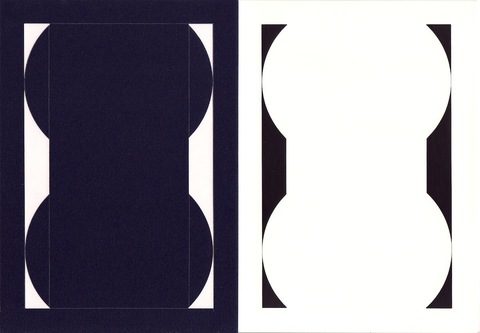
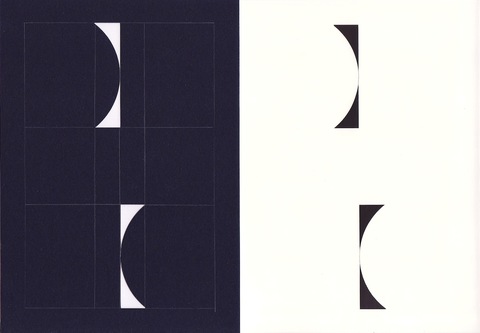
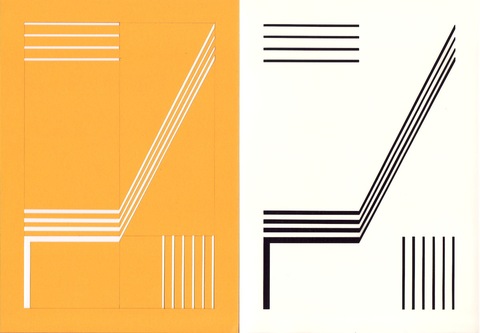
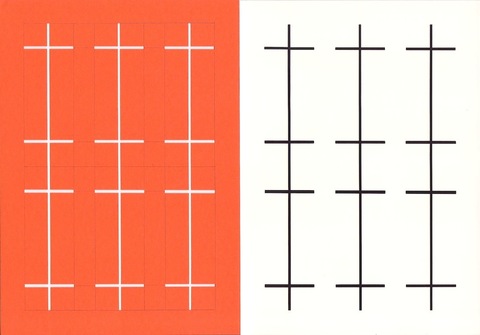
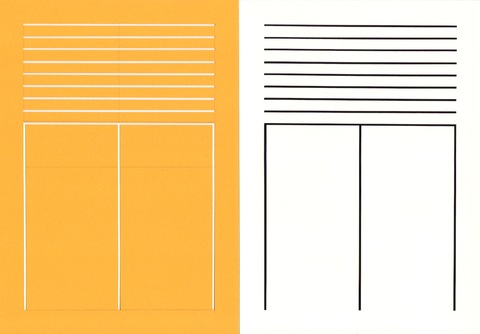
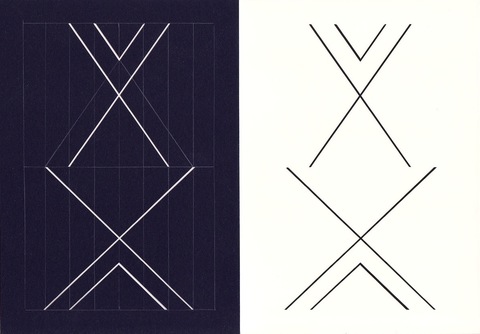
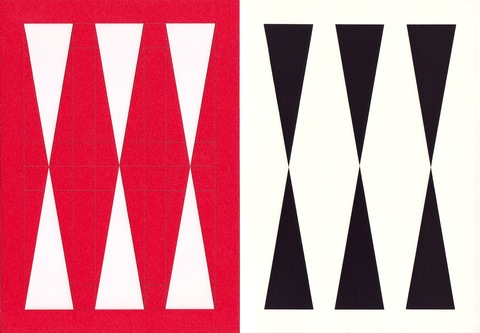
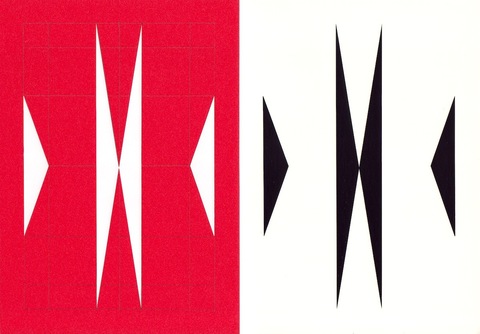
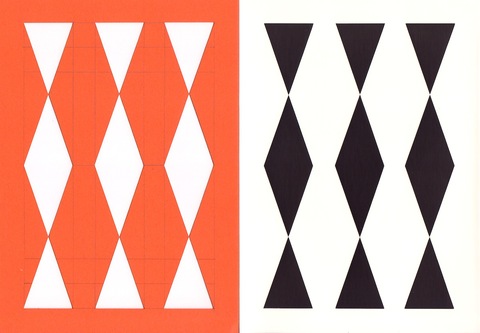
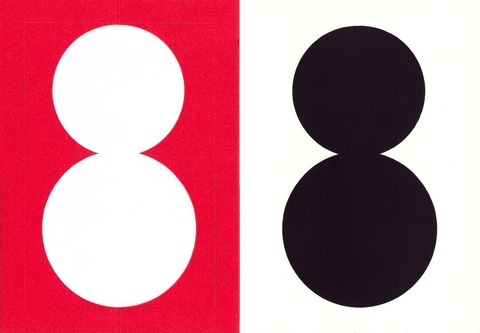
palettes. Instead, Caldicott composes his imagery in a painstaking way,
cutting and assembling paper in the physical realm before standing back
and assessing, then clicking the shutter. There are further stages: the
bringing together of two compositions in a single frame to create the
densely layered structures, and then finally the proofing stage as a
means of enhancing and trimming, fine-tuning the image before it is
printed at scale.

This work seeks to reclaim abstraction's aesthetic roots, a means of
generating art without overt agenda, carefully considered yet without an
overbearing political or social structure, and also explore the
multiple viewpoint and glimpses generated by fragmentation. For many, such an
approach appears oxymoronic, counter to the inherent properties of
contemporary artistic production; that it must be challenging and, if
possible, overturn an old order in favour of something new. Caldicott's is
an artistic response to modernism, a genre that has remained largely
self-contained, hermetically-sealed against external critical thinking.
One of the central themes of this work is the use of the modern house as
a generator of form, rather than a fixed political statement or even,
in line with more contemporary strands of thinking, as an additional
element of lifestyle. This approach is closer to the formal gymnastics
of the 21st architectural avant-garde, which enjoys far wider
dissemination with the culture at large.

The photographic pieces have a rare physicality, with layered
structures that are ostensibly characteristic of painterly and sculptural
abstraction, yet in a post-abstract age are allowed to stand alone. It wasn't
until the Sixteenth Century that shadows and perspective began to make
their contribution to painting, deepening the canvas in an allegiance
of art and science, turning the flat pictorial plane into a space of
wonder, with perspective considered a kind of cosmic confidence trick.
Artists learned to master these devices. With new technology came the
realisation that the machine age gave rise to inevitable abstractions, as
the shutter jammed and the distorted effect of multiple exposure prints
was transferred from failed photographic plate to avant-garde
canvasses. Self-conscious abstraction was a means of exploring the trials and
triumphs of modernity, whereas Caldicott deals not in subverting
reality, but in building up new forms from underlying geometrical constants.
The resulting images are isolated from their sources, with bold colour
palettes and a satisfying level of depth created by the overlaying
process.

The mechanically-reproduced work of art has evolved considerably
throughout the century, culminating in Walter Benjamin's mourned 'aura' -
that which withers in the age of mechanical reproduction is the aura of
the work of art (2). A contemporary observer might note that electronic
duplication is the primary means of visual communication, and that the
original work of art has all but vanished. This is a world based on
image, their novelty accelerated by digital processes. Society is
seemingly hungry to consume - and generate - new imagery, adapting them for
downloadable wallpapers, desktop themes, photo-sharing, weblogs, phone
cameras, and countless other devices that promise infinite customisation.
Yet it is also a visually degraded culture, where artefacts are
squeezed and stretched to email, download and share. The object has become
more transient, less reliant on the physical realm - some of them may
indeed never enter the physical realm, just as the newer generations will
never know the physical form of media that only a few decades before
seemed permanent and unchanging - the compact cassette tape, VHS, vinyl
record, even the CD. Just as the jpeg data format and mp3 audio format
represent a sliding scale of quality, gradually clipping out levels of
detail, grain and sharpness, so our cultural memories of slowness
recede into the background.

Though Caldicott's work skirts around the edge of processes described
above, the artist's primary aim is to deliberately evoke a dynamic
fragmentary moment, translating the remnants of a physical object, once
fixed and reliable, into something with a sense of fleeting impermanence.
Admittedly, these works might have more claims to permanence than an
image taken with a phone camera, for example, but in truth their
survivability is an unknown quantity: in historical terms, digital-based imagery
is embryonic. Humankind is moving into the future towing a vast
accumulation of cultural production, products whose slender shelf lives are
now turning into half lives of use value and exponentially longer
centuries of potential decay. The things that mean the most to us - the least
superficial - are those that face erasure. We are condemning ourselves
to a future of eternal back-ups, constantly updating the means of
preserving the past so as to take it with us. Yet paradoxically our
digitised memories are combined with a disposable visual culture, guided by a
constellation of slowly evolving symbols, colours, names, labels, logos,
brands, trademarks, and signs.

Caldicott's artistic furrow is ploughed not in open revolt but in quiet
opposition to this daily unspooling of imagery. Digital processes are
used, but speed and cloning aren't the issue. Speed is now a universal
experience, and while technology remains at the heart of the world's
most-pressing problems, there are many who would counter that it also
provides us with the best hope of salvation, a return to Modernism's
initial, innocent, optimism. Instead, Caldicott has progressed from
assemblage-style collage compositions through to the arrangement of real objects
in space, focusing on pure form and colour, composing things in an
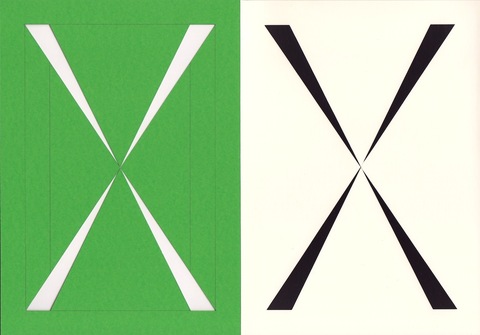
almost notational, rhythmic way. This current series marks a departure from
modernist serenity towards a focus on dynamism and force, compositions
that mimic the forces of explosions and fractures.

Today, abstraction serves many purposes. A daily paper is an
abstraction, a filter, a barrier between the truth and the perceived truth,
creating a series of individual realities. Today, we know that we can shape
our realities, and that abstraction is just a means of mediating.
Whereas when abstraction was a new concept, the masses saw it not as a new
way of seeing, but as a deliberate destruction of the existing orders.
Contemporary consumer culture treats the past like an assemblage, a
giant merzbau, that one can clip from like a shrub, then sample, copy,
imitate, steal, pay homage to, and subvert. Caldicott is against such
ostentatious novelty, instead inviting us to reconsider the tumultuous
speed of cultural production and take a considered step back from the
maelstrom. We now take abstraction for granted: it has been subsumed into
popular culture.

Caldicott's work strives against this new order, by acknowledging the
role of the fleeting moment and the subconscious in the interpretation
of space. Artistic Constructivism began by using form and composition as
emotional resonator, an exploration of the power of pure form as
opposed to the loaded narrative of the historian. Yet since abstraction
ascended to the mainstream and followed modernist art and architecture to
adopt a similarly dominant, static viewpoint, pure composition has lost
its power to create a fresh angle. Richard Caldicott has taken what
was once solid and static and urged us to re-visit it, a glimpse past the
underlying framework into a more layered, complex state. This is work
that requires a degree of selfinterpretation, but rewards a new way of
looking with fresh eyes on the forms that continue to shape
contemporary life.


(1) See The Cultural Cold War: The CIA and the World of Arts and
Letters
, Frances Stonor Saunders, The New Press, New York, 1999, and
Building the Cold War: Hilton International Hotels and Modern Architecture,
Annabel Jane Wharton, University of Chicago Press, Chicago, 2001
(2) Walter Benjamin, The Work of Art in the Age of Mechanical Reproduction,
1936

< back


Richard Caldicott